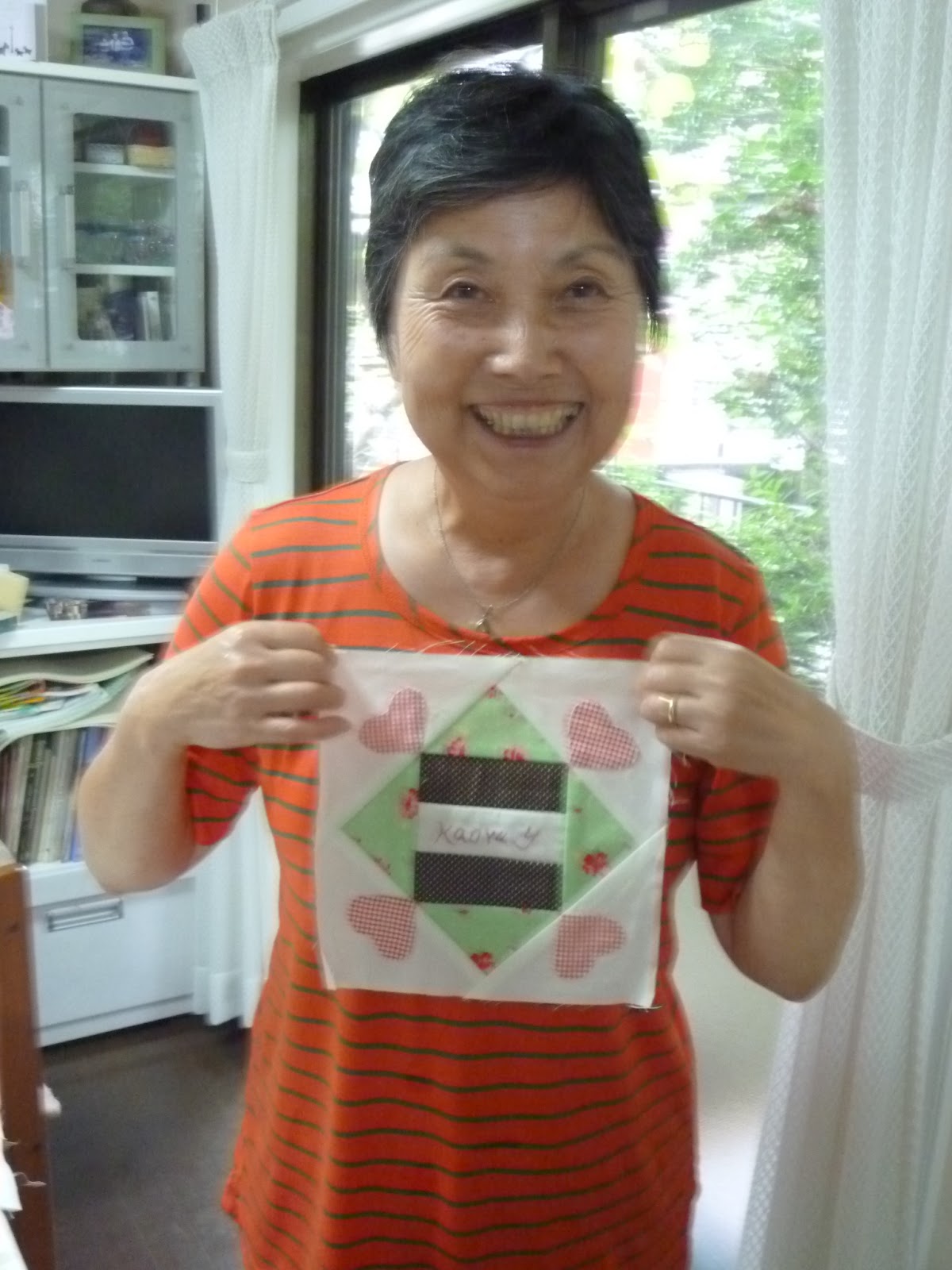
Sensei asked my classmates and some other quilters I had met through her to make a block for a friendship quilt for me. Today I received the blocks which really reflect the personalities and color choices of each maker. When I get home I need to add sashing and probably a center square to even things out a bit. What I'm wondering now is if anyone out there has a good idea for the type/color of sashing fabric? Please set me know what you think.
Showing posts with label japanese food. Show all posts
Wednesday, September 19, 2012
Day Six
Sensei asked my classmates and some other quilters I had met through her to make a block for a friendship quilt for me. Today I received the blocks which really reflect the personalities and color choices of each maker. When I get home I need to add sashing and probably a center square to even things out a bit. What I'm wondering now is if anyone out there has a good idea for the type/color of sashing fabric? Please set me know what you think.
Tuesday, October 11, 2011
La France
It just occurred to me that when I was growing up my mother used a laundry product called La France. I think it was "bluing." You know, to make your whites look whiter? Am I speaking to people with blank looks on their faces and no idea what I'm talking about this time?
Why I thought of La France is that there is something in Japan that is called La France (ra furansu). It is a fruit that is in the stores now. For all the world it looks like a Bartlet Pear until you grasp the size of it. It is enormous!
In the picture to the left is a La France with a ruler in front showing it to be at least 12 cm long. (Are you out there Ed?) Beside it is a 500 ml carton of La France drink (1% real fruit juice!) It took me a while to figure all of this out a few years back because Japanese people tend to think if something is written in katakana - the alphabet for foreign words - it should follow that foreigners should know what it means.
By the way, the La France is like a Bartlett Pear on the inside too, with the same taste and texture.
While we're on the subject of food, I found this to be amusing. On the left we have a small package of potato salad. In Japan you're likely to find carrot, cucumber and a bit of whole kernel corn in it, but it tastes pretty good. When I first arrived in 1999 my first taste of it was in a package of mixed sandwiches between two pieces of white bread at an after church lunch
Here we have the empty plastic tray with the lettuce leaves printed on it. I often tell people at home that almost everything is done in Japan with an eye toward aesthetics. So, rather than putting in real lettuce leaves that would just go limp and nasty in a day and everyone would throw away anyway, they print the leaves on the tray. It makes the potato salad look more attractive without the waste.
Why I thought of La France is that there is something in Japan that is called La France (ra furansu). It is a fruit that is in the stores now. For all the world it looks like a Bartlet Pear until you grasp the size of it. It is enormous!
In the picture to the left is a La France with a ruler in front showing it to be at least 12 cm long. (Are you out there Ed?) Beside it is a 500 ml carton of La France drink (1% real fruit juice!) It took me a while to figure all of this out a few years back because Japanese people tend to think if something is written in katakana - the alphabet for foreign words - it should follow that foreigners should know what it means.
By the way, the La France is like a Bartlett Pear on the inside too, with the same taste and texture.
While we're on the subject of food, I found this to be amusing. On the left we have a small package of potato salad. In Japan you're likely to find carrot, cucumber and a bit of whole kernel corn in it, but it tastes pretty good. When I first arrived in 1999 my first taste of it was in a package of mixed sandwiches between two pieces of white bread at an after church lunch
Here we have the empty plastic tray with the lettuce leaves printed on it. I often tell people at home that almost everything is done in Japan with an eye toward aesthetics. So, rather than putting in real lettuce leaves that would just go limp and nasty in a day and everyone would throw away anyway, they print the leaves on the tray. It makes the potato salad look more attractive without the waste.Saturday, June 4, 2011
Zeri de Zero
A food that appears here all year round, but even more in the warmer months is individual servings of gelatin usually with fruit and/or yogurt in it. The gelatin is related to agar rather than the animal based gelatin we use in the US. The texture is a bit different, but easy to get used to. It is cool and refreshing and not as sweet or strongly flavored as Jello.
This season there is a new product in the markets. Phonetically it's zeri de zero - zeri being as close as Japanese seems to be able to get to Jelly. (Jelly is what the British call gelatin.) So what about the zero? They are claiming that there aren't any calories in this stuff. There are, however, blocks of nata de coco - the meat of immature coconut, and blocks of collagen in the gelatin. It comes in mikan (tangerine) strawberry and muscat grape (never to be confused with concord!) varieties. A bit of flavor, three different textures and no calories. What more could a sugar avoiding person ask for?
Subscribe to:
Posts (Atom)